
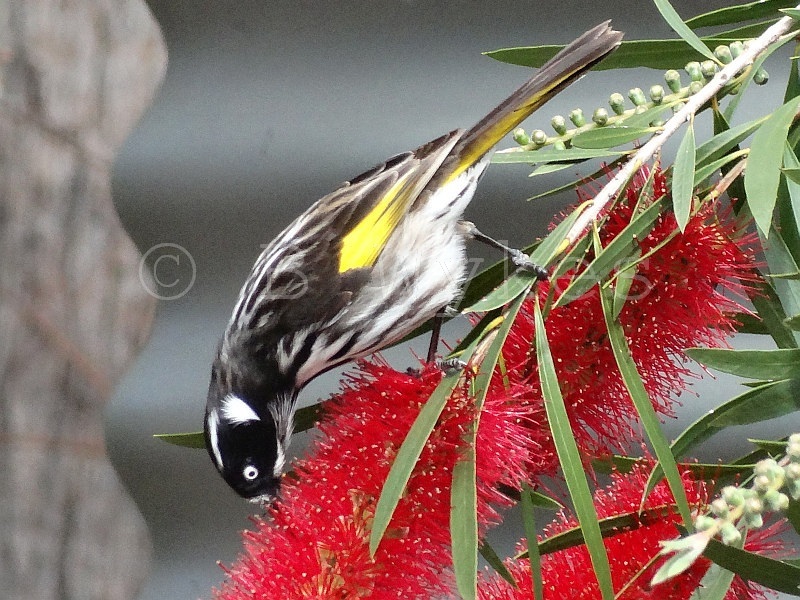
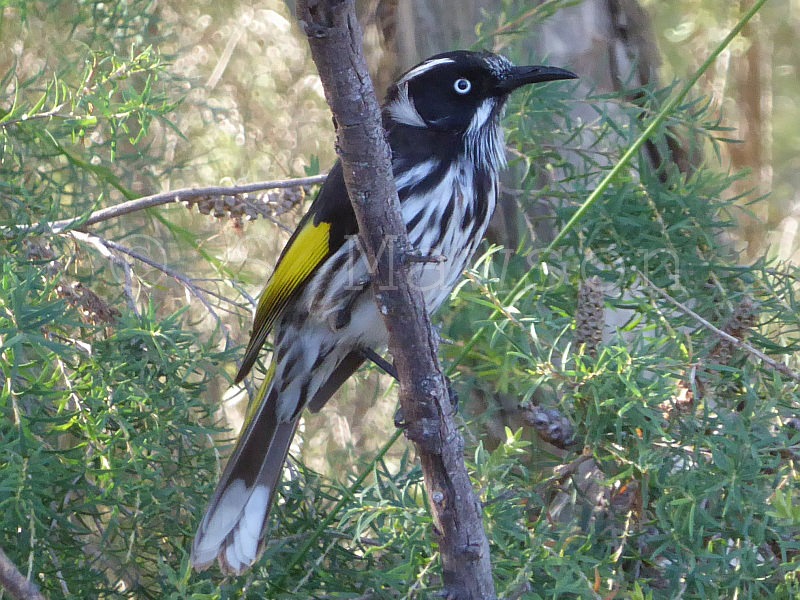
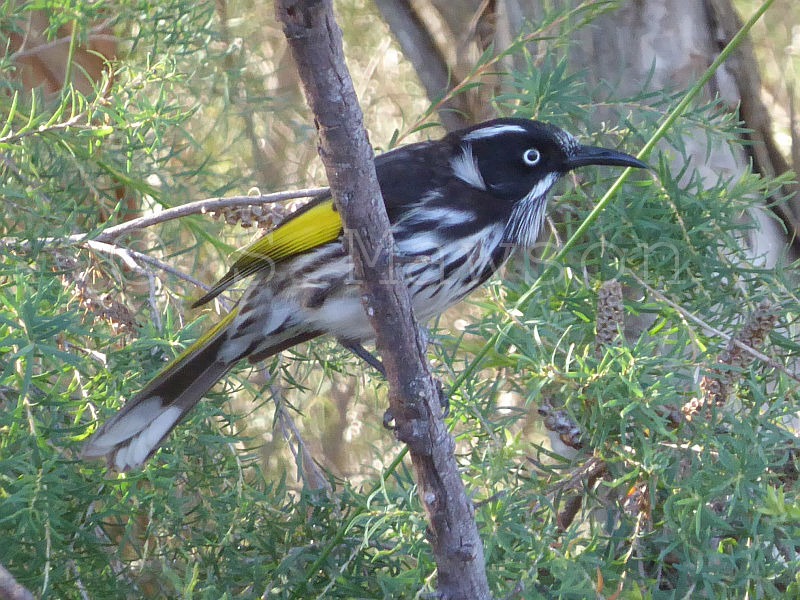
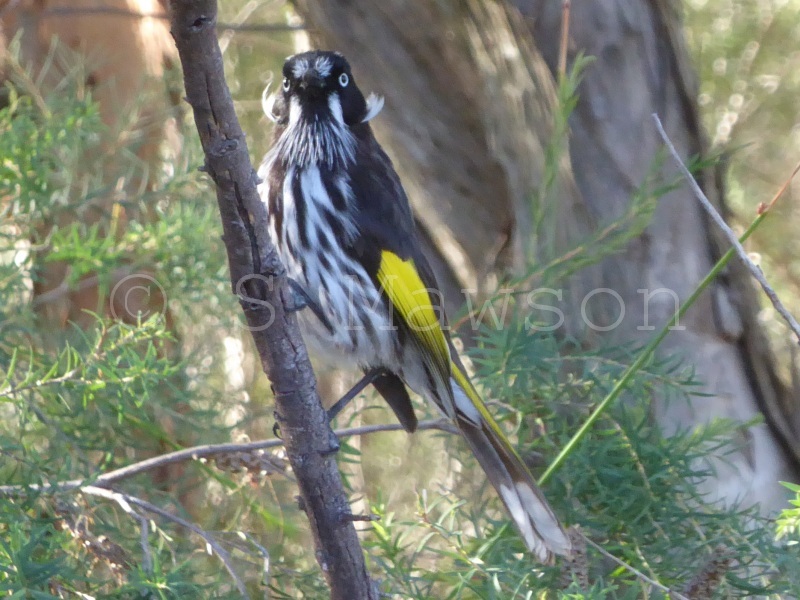
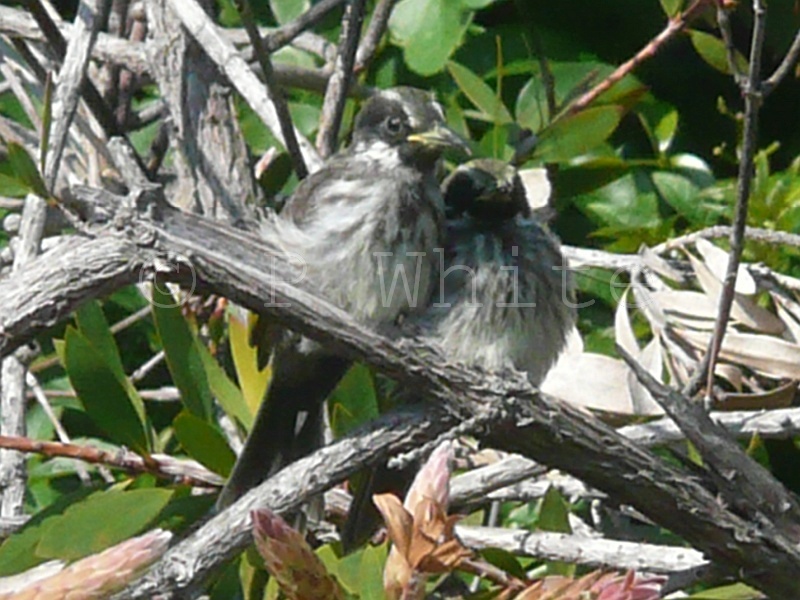
New Holland Honeyeater
Scientific name: Phylidonyris novaehollandiae
Phylidonyris is from the French word phylidonyre, combining the name phyledon, meaning honeyeater, and Cinnyris, being the genus for sunbirds, of which the honeyeaters were originally considered to be members. Novaehollandiae means from New Holland.
Bandin (ban’deen). The same name is also used for the White-cheeked Honeyeater.
New Holland Honeyeaters are found from north of Perth, throughout the southwest to near the South Australian border. The eastern population is found from west of Spencer Gulf in South Australia, along the south coast to north of Brisbane in Queensland. They are also found in Tasmania.
New Holland Honeyeaters are up to 20 centimetres long with a 23 centimetre wingspan.
The furthest distance recorded by the Australian Bird and Bat Banding Scheme for this species of bird to travel is 330 km. The oldest bird recorded was still alive when its band was read in April 1984, 14 years 5.2 months after being banded (information as at 21 June 2012).
Handbook of Australian, New Zealand and Antarctic Birds. Various contributors.
What Bird is That? Neville W Cayley. 1978
Aboriginal names of bird species in south-west Western Australia, with suggestions for their adoption into common usage. Ian Abbott. 2009. Conservation Science Western Australia Journal. Volume 7 No 2 https://library.dbca.wa.gov.au/Journals/080559/080559-07.015.pdf
Australian Bird and Bat Banding Scheme http://www.environment.gov.au/biodiversity/science/abbbs/abbbs-search.html
Atlas of Living Australia https://bie.ala.org.au/species/https://biodiversity.org.au/afd/taxa/da002998-b551-4328-ac4e-5e04fc72708b